Crafted for Court: Early Ming Dynasty Imperial Bowl
1st November 2025-

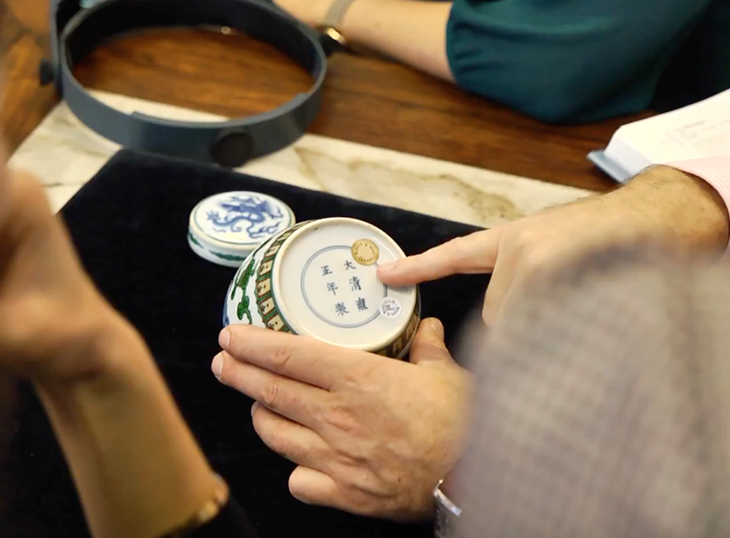
Lot 201, an extremely rare Chinese blue and white 'Dragon' bowl or mortar, Xuande mark of the period 1426-35
-

Xuande reign mark
During the short but peaceful reign of the Xuande Emperor (1425–1435), the fifth ruler of the Ming dynasty, innovation and technical excellence flourished at the imperial Jingdezhen kilns. Imperial porcelain production had developed rapidly under Xuande’s grandfather, the Yongle Emperor, but Xuande, himself an artist and connoisseur, took a personal interest in the kilns’ output. He became the first emperor in Chinese history to send court officials and eunuchs to Jingdezhen to directly supervise production. This close oversight led to greater standardisation in the form and design of imperial wares and it was during the Xuande period that the practice of painting reign marks on ceramics was first introduced.
Offered in the upcoming Fine Asian sale on 11th November is an extremely rare Chinese blue and white ‘dragon’ bowl or mortar which bears the six character Xuande mark (Lot 201). A classic design for Imperial Xuande ware, this ‘dragon’ bowl or mortar is decorated with two, animated five-clawed dragons depicted amongst flames and clouds, with crashing waves to the rim.
The dragon was known to be a symbol of the emperor from the early 15th century and heavily potted bowls painted with dragons, such as the present lot, are known in two different types: the 'dice' bowl, with a glazed interior and the reign mark in a double circle in the well (such as this example held within the Victoria and Albert Musuem collection), and the much rarer 'mortar' bowl, which has an unglazed interior and the reign mark painted in a line under the rim. At just 16.5cm in diameter (6½ in), the unglazed interior of this mortar points to its purpose as a receptacle for grinding herbs and medicines, most likely for the personal use of the emperor and his trusted physician.
‘Heap and pile’
This piece also reflects the Xuande Emperor’s preference for a purplish cobalt blue glaze. During the reigns of Yongle (1403-1425) and Xuande (1426-1435), the main source of colour in blue-and-white porcelain was smalt cobalt, brought by the returning fleets of Zheng He’s (1371-1433) maritime expeditions. Subsequently, more rigorous firing processes resulted in subtle displays of ‘heap and pile’ characteristics, with varying tones of rich and brilliant cobalt blue visible in the glazed surface.
This remarkable ‘dragon’ bowl or mortar was consigned from a private collection in Dorset, having been purchased in 2014 from John Berwald of Berwald Oriental Art.